
If you plan to construct, modify, or operate a recycled water reuse facility in Idaho, you must first obtain a permit from DEQ. Idaho’s Recycled Water Rules (IDAPA 58.01.17) establish the permitting requirements to protect public health and prevent pollution of surface water and groundwater.
Recycled water is water that has been treated to be safe for its intended beneficial use, such as irrigation, groundwater recharge, landscape impoundments, toilet flushing in commercial buildings, dust control, and more. The most common form of water reuse is the irrigation of agricultural crops.
Quick Actions
Apply for a Reuse Permit
- Schedule a pre-application conference with your DEQ regional reuse contact at least a year in advance.
- Read the Recycled Water Rules
- Review the Reuse Permit Application Plan of Operation Checklist
- Complete the required forms:
- After the final preapplication conference, submit the required forms to the appropriate DEQ Regional Office:
Make a Payment
Online (Preferred)
- Pay through the DEQ Payment Portal
By Mail
- Make checks payable to: DEQ
- Memo: Invoice number and “Reuse Annual Fee Payment”
- Mail to:
Idaho DEQ Financial Office
1410 N. Hilton St.
Boise, ID 83706
Report a Permit Violation
- Report public health emergencies immediately to (800) 632-8000.
- Notify your DEQ regional reuse contact within 24 hours.
- Submit a written report within 5 days to your DEQ regional office.
- If the incident involves a discharge to the Water of the United States (WOTUS), call the IPDES hotline at (833) IPDES24 or (833) 473-3724.
Reuse Permit Program Overview
Reuse is the practice of reclaiming treated wastewater and applying it for beneficial purposes rather than discharging it to a surface water. By treating and reusing water for fit-for-purpose uses, communities can enhance water resilience, lower infrastructure and supply costs, and protect environmental resources. This closed-loop system supports sustainable growth by turning wastewater into a valuable resource.
Benefits
- Agricultural Productivity — Reliable water supply for Idaho’s crop irrigation.
- Circular Water Economy — Keeps water in productive use for as long as possible.
- Reduced Freshwater Demand — Decreases pressure on regional water supplies.
- Reduced Surface Water Nutrient Loading — Land application at agronomic rates reduces nutrient loading to Idaho rivers and streams.
Beneficial Uses of Recycled Water
- Cleaning Water — Washing outdoor surfaces, roads, and work areas.
- Crop Irrigation — Irrigate agricultural crops, reducing freshwater demand.
- Dust Suppression — Construction sites, unpaved roads, and industrial areas.
- Groundwater Recharge — Must comply with IDAPA 58.01.11 and IDAPA 58.01.17, as applicable.
- Landscape Irrigation — Parks, lawns, golf courses, and landscaped areas.
Types of Reuse Permits
DEQ issues two types of reuse permits—municipal and industrial.
Idaho does not permit recycled water systems for individual residential applications.
Note: IDAPA 58.01.17.609 authorizes DEQ to issue general reuse permits for facilities with similar characteristics in similar geographic areas; however no general reuse permits are currently issued.
Learn more about the two types of reuse permits in the dropdowns below.
Municipal Reuse Permits
Municipal reuse permits regulate recycled water derived from municipal wastewater. These permits classify recycled water into five distinct categories (Classes A through E), each bound by specific treatment standards and approved applications:
- Class A (Highest Treatment) — Advanced treatment including filtration and stringent disinfection. Suitable for uses where human contact is more likely, such as landscape irrigation (including residential areas), public spaces, and some groundwater recharge activities.
- Class B — Highly treated and disinfected. Can be used for a wide range of applications including irrigation of food crops and many public and commercial uses, but is not allowed for residential irrigation distribution.
- Class C — Secondary treatment and disinfection without filtration. Typical applications include irrigation of processed food crops, fodder crops, and certain orchards.
- Class D — More restricted uses. Primarily used for irrigation of non-food or indirectly consumed crops and in settings with limited public access.
- Class E (Lowest Treatment) — Most limited use category. Restricted to applications with minimal potential for human exposure, such as irrigation of non-food crops in controlled environments.
Industrial Reuse Permits
Industrial reuse permits govern recycled water generated by industrial processes, including food processing plants. Because these discharge characteristics fluctuate with production rates and operational schedules, permits evaluate the specific source, treatment methods, and intended end use of the water. In Idaho, these facilities primarily support food processing sectors such as potato, sugar beet, onion, dairy, and meat production.
Apply for, Renew, or Modify a Reuse Permit
Apply or Renew
Follow these steps to apply for or renew a permit:
- Schedule a pre-application conference with your DEQ regional reuse contact at least a year in advance.
- DEQ will issue a Letter of Needs after the pre-application meeting.
- Read the Recycled Water Rules.
- Review the Reuse Permit Application Plan of Operation Checklist.
- Complete the required forms:
- Reuse Permit Application Forms
- Reuse Review Transmittal Form
- Gather information outlined in the Letter of Needs
- Submit the required forms and materials:
- Permit renewals must be submitted 6 months before permit expiration.
- Documents must be in PDF or Excel format, and must be stamped, signed, and dated as appropriate.
- Upload the documents to the appropriate DEQ Regional Office using the cloud folders linked below:
After you apply:
- DEQ Reviews your Application for Completeness
- Incomplete applications are returned for revision.
- If all requirements are met, DEQ issues a completeness determination.
- Preliminary Decision
- DEQ determines whether to prepare a draft permit or deny the application.
- Public Notice and Comment
- If a draft permit is prepared, DEQ provides public notice and an opportunity for public comment.
- Final Permit Issuance
- The permitting process may take a year or longer.
- Reuse permits are typically issued for terms of five to ten years.
Permit Modifications
If you need to make changes to an existing reuse facility or permit, you may need to request a permit modification.
Major modifications require public notice. Minor modifications are administrative in nature.
Major modifications may include:
- Adding or expanding management unit acreage
- Changes to the treatment system
- Changes in recycled water quality or wastewater source
- Operational changes requiring DEQ approval
To request a permit modification:
- Complete the Reuse Review Transmittal Form.
- Submit the required forms to the appropriate DEQ Regional Office using the cloud folders linked below:
- Documents must be in PDF or Excel format, and must be stamped, signed, and dated as appropriate.
- DEQ will determine whether the request is a major or minor modification and notify you of any additional requirements.
Fees and Payments
Annual reuse permit fees are established in IDAPA 58.01.14.170.02. Fees are assessed annually on October 1 and are due by December 30.
Annual fees vary based on permit type:
| Permit Type | Annual Fee |
|---|---|
| De minimis | $500 |
| Industrial | $3,000 |
| Municipal — over 15,000 people | $3,000 |
| Municipal — 1,000 to 15,000 people | $1,000 |
| Municipal — under 1,000 people | $500 |
| Private domestic or other* | $750 |
| General Reuse Permit (flat fee) | $100 |
*Sewer Districts are considered private domestic or other.
How to Pay
Online (Preferred)
- Pay through the DEQ Payment Portal
By Mail
- Make checks payable to: DEQ
- Include: Invoice number and “Reuse Annual Fee
Payment” in the memo line. - Mail to:
Idaho DEQ Financial Office
1410 N. Hilton St.
Boise, ID 83706
Fee Questions? Contact:
Kerry Goade
Wastewater Permits Bureau Chief
(208) 373-0278
Kerry.Goade@deq.idaho.gov
Compliance Requirements
Reuse permit holders must comply with all permit conditions at all times. Standard conditions (IDAPA 58.01.17.500) apply to all reuse permits:
- Properly operate and maintain all permitted facilities.
- Allow DEQ entry and access to all reuse facility areas.
- Report all noncompliance incidents to your DEQ regional reuse contact.
- Comply with IDAPA 58.01.11 to protect groundwater beneficial uses
- Submit annual reports with all required monitoring and operational data.
- Maintain a current Plan of Operation and notify DEQ of material changes.
- Prevent unauthorized discharges to surface water and maintain backflow prevention devices.
More information on compliance requirements is outlined in the dropdowns below.
Annual Reporting
All reuse permittees submit an annual report to their DEQ regional office per permit conditions. A Quality Assurance Project Plan (QAPP) is required for all monitoring data collection, analysis, and reporting.
| Monitoring Type | Example Parameters | Frequency |
|---|---|---|
| Recycled water quality | BOD₅, TSS, TDS, pH, turbidity, total coliform, nitrogen, phosphorus | Continuous or daily to monthly |
| Hydraulic loading | Flow volume per management unit | Daily when applying; compiled monthly |
| Groundwater monitoring | Nitrogen, metals, conductivity | Quarterly to annually |
| Soil monitoring | Nitrogen, phosphorus, TDS | Periodically |
Plan of Operation
All reuse permits require a Plan of Operation under IDAPA 58.01.17.300. The Plan of Operation must be developed, implemented, and updated whenever material changes occur.
Required Contents Based on Water Use
- Site Management Plans (per Management Unit) — Operational plan describing how recycled water is applied and managed.
- Crop Management Plans — Crop types, schedules, yield estimates, nutrient uptake rates, and irrigation water requirements.
- Irrigation System Efficiency — System type, distribution uniformity, and operational considerations.
- Monitoring Maps — Maps showing reuse application areas, monitoring locations, and key infrastructure.
- Personnel Qualifications — Identification and qualifications of responsible operators.
- Emergency Response Procedures — Procedures for operational failures, spills, or system malfunctions.
- Temporary Cessation Procedures — Instructions for safely stopping reuse activities per IDAPA 58.01.17.300.
DEQ Inspections
DEQ staff conduct compliance inspections at reuse facilities per IDAPA 58.01.17.500. During compliance inspections, DEQ may review:
- All aspects of permit and rule compliance
- Annual reports and monitoring data
- Current Plan of Operation
- Management unit maps and field conditions
- Groundwater monitoring well records
- Buffer zones and signage compliance
- Backflow prevention device records
- Storage lagoon conditions and seepage test results
Reporting Noncompliance/Permit Violations
If a noncompliance incident occurs:
- Notify the appropriate DEQ regional reuse contact within 24 hours.
- Submit a written report within 5 days to your DEQ regional office.
- For public health emergencies, call the 24-hour Idaho Emergency Medical Services Communications Center at (800) 632-8000.
- If the incident involves a discharge to the Water of the United States (WOTUS), call the IPDES hotline at (833) IPDES24 or (833) 473-3724.
Staff Contacts
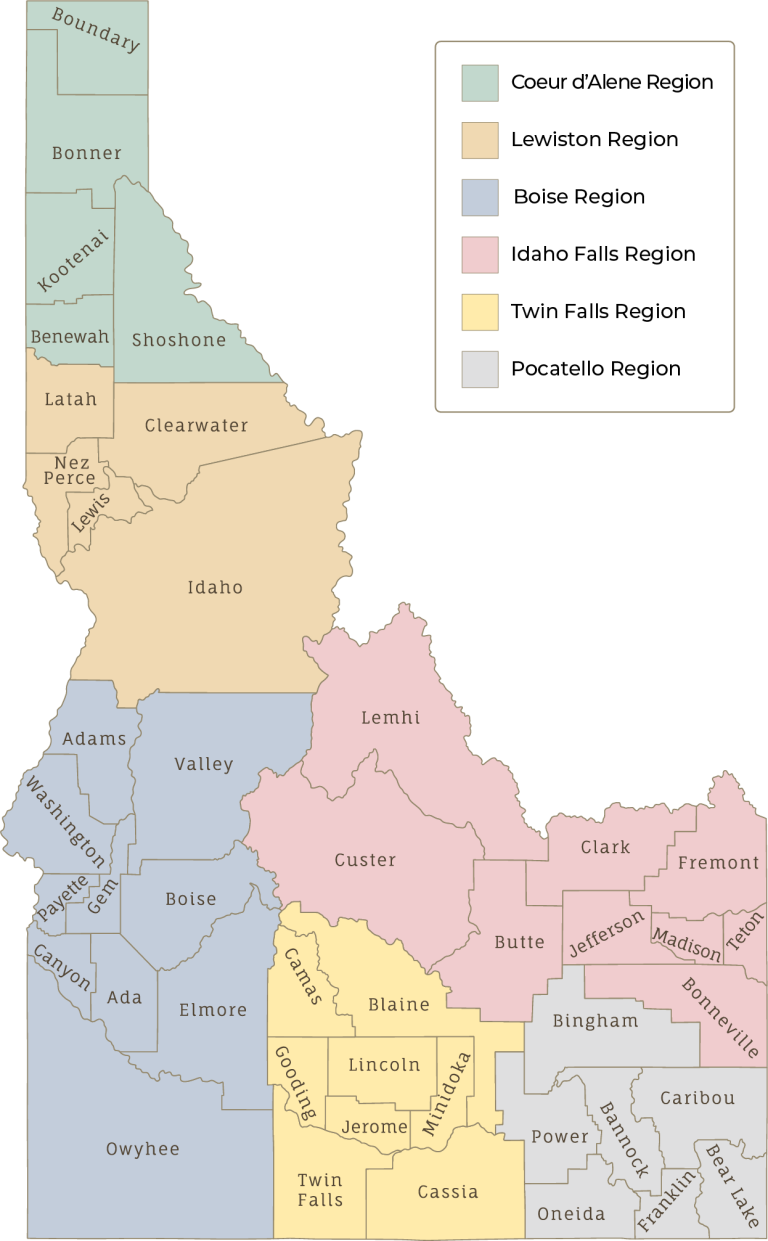
Regional Reuse Permitting and Compliance Contacts
Boise Region
Valerie Greear
(208) 373-0459
valerie.greear@deq.idaho.gov
Coeur d’Alene Region
Katy Baker-Casile
(208) 666-4640
katy.baker-casile@deq.idaho.gov
Idaho Falls Region
Carlin Feisthamel
(208) 528-2675
carlin.feisthamel@deq.idaho.gov
Pocatello Region
Allan Johnson
(208) 239-5008
allan.johnson@deq.idaho.gov
Twin Falls Region
Kevin Kruger
(208) 737-3868
kevin.kruger@deq.idaho.gov
Lewiston Region
Breanne Blaisdell
(208) 799-4886
breanne.blaisdell@deq.idaho.gov
State Office Contacts
Statewide Reuse Program Coordinator
Emma Wooldridge
(208) 666-4604
emma.wooldridge@deq.idaho.gov
Enforcement Coordinator
Ben Johnson
(208) 373-0516
ben.johnson@deq.idaho.gov
Compliance and Enforcement Supervisor
Nicole Mattfeldt
(208) 373-0131
nicole.mattfeldt@deq.idaho.gov